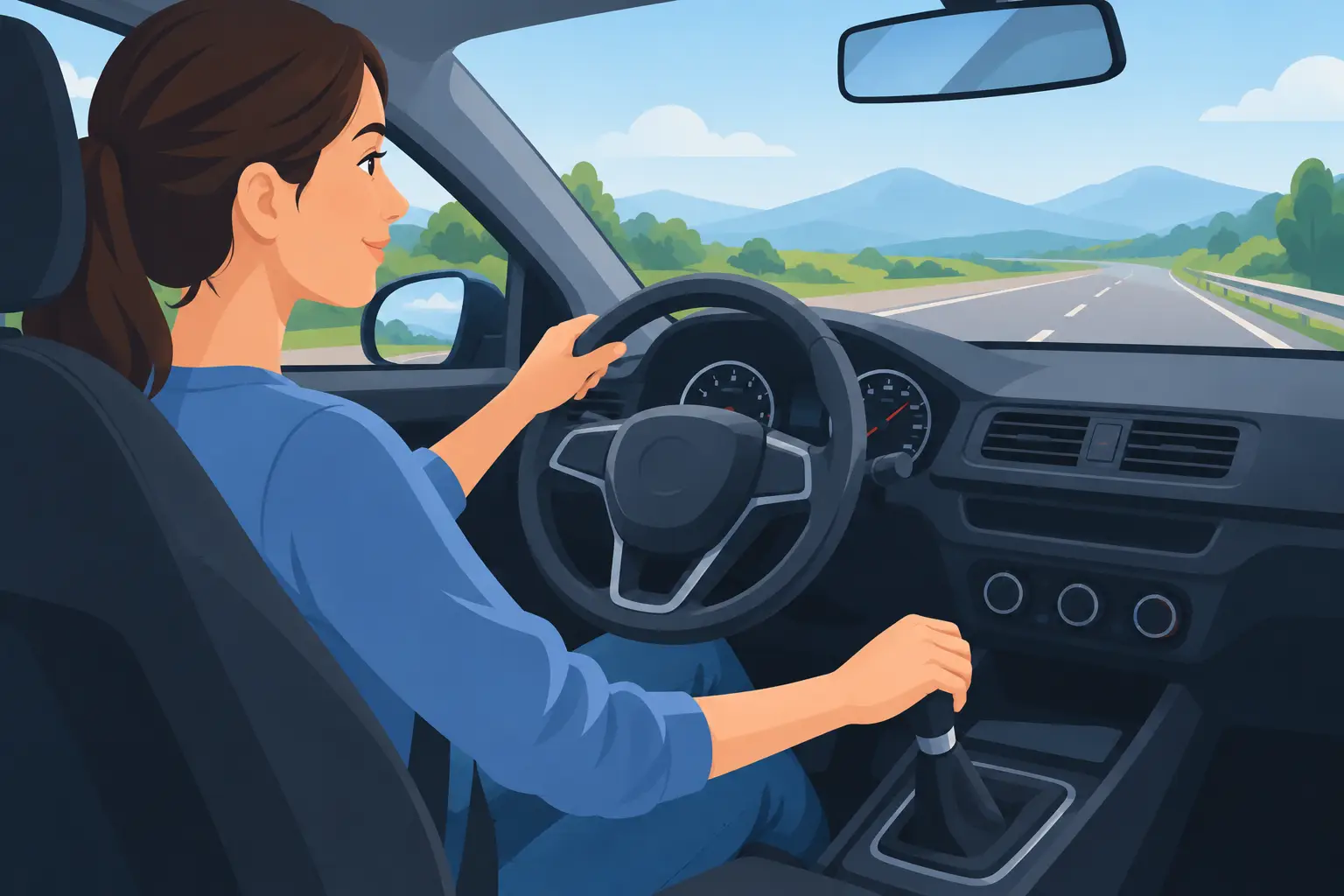
Learn how to learn to drive manual with clear, practical steps on clutch control, gears, hill starts and building confidence for your driving test safely.
The first time you pull away in a manual car, the clutch can feel like it has a mind of its own. A stall at the lights or an over-rev is normal, not a sign that you cannot do it. Knowing how to learn to drive manual is largely about breaking each movement into manageable stages, then repeating them with an approved instructor until they become natural.
Manual driving gives you direct control over the gears and can leave you with more choice when buying a car. It does require more coordination than automatic driving, especially in traffic, but most learners make steady progress when their lessons follow a clear plan tailored to their experience.
Start with the controls, not the road
Before moving anywhere, get comfortable with the three pedals. From left to right, they are the clutch, brake and accelerator. Your left foot operates the clutch only. Your right foot moves between the brake and accelerator. Keeping this simple rule in mind prevents a common beginner mistake: trying to brake with the left foot.
Your instructor will also explain the gear lever pattern, handbrake or electronic parking brake, mirrors, steering adjustments and dashboard controls. Take time to set your seat so you can fully press the clutch without stretching. You should be able to hold the steering wheel comfortably with a slight bend in your arms and see clearly through all mirrors.
There is no prize for rushing this stage. When the controls feel familiar while parked, your attention is freer to deal with the road once the car starts moving.
Learn clutch control before chasing speed
Clutch control is the skill that makes manual driving feel smooth. The clutch connects the engine to the wheels. As you lift it gradually, you reach the biting point - the point where the car is ready to move.
On a quiet, level road, your instructor will usually guide you through a controlled pull-away. With the clutch fully down, select first gear. Prepare the car, check around you, then bring the clutch up slowly to the biting point. Add a small amount of accelerator if needed, release the parking brake and continue lifting the clutch gently as the car moves.
At first, focus on feeling rather than trying to memorise an exact foot position. Each car’s clutch can feel slightly different. You may notice a change in engine sound, a slight dip in the front of the car or a gentle pull forward. That feedback helps you find the biting point next time.
Stalling is part of learning. If it happens, secure the car, restart calmly and work through the routine again. The safest drivers are not those who never make a mistake during lessons. They are the ones who recognise it, recover correctly and stay composed.
Build a consistent moving-off routine
A reliable routine reduces nerves and helps you avoid missed checks. Your instructor may use a particular method, but the key is to prepare the car, observe properly and move only when it is safe. With practice, checking mirrors and blind spots, selecting first gear and finding the biting point will become one connected process.
Do not worry if this takes several lessons. Learners progress at different speeds, and concentrated lessons can be particularly useful because the repetition is fresh each day.
How to learn to drive manual through the gears
Once you can move away smoothly, you will learn when to change gear. First gear is for moving off and very low speeds. As the car gathers pace, changing into second and then higher gears allows the engine to work efficiently and keeps the drive smoother.
Listen to the engine and watch how the car responds. If it sounds strained or noisy, it may be time to move up a gear. If the car feels like it is labouring at a low speed, change down. Early on, your instructor may tell you exactly when to change. Over time, you will learn to judge it for yourself.
A gear change is a calm sequence: ease off the accelerator, press the clutch fully, select the next gear, lift the clutch smoothly and return to the accelerator. Avoid staring at the gear lever. Brief glances may be needed at the very beginning, but your aim is to keep looking ahead so you can respond to hazards.
Changing down is just as important. Before a junction, roundabout or bend, reduce your speed first, then choose a gear suitable for the speed you will be travelling. This gives you better control and means you are ready to move safely when the road opens up.
Practise stopping, starting and hill starts
Town driving involves frequent changes of pace. You will need to slow down, stop and pull away again without losing control of the car or your observations. Begin on quieter routes before progressing to busier roads, multi-lane junctions and stop-start traffic.
Hill starts are a common concern, but they are a skill rather than a test of nerve. On an uphill slope, the parking brake helps keep the car still while you find the biting point and add enough accelerator. When the car feels ready to pull, release the brake and move away with control. If the car rolls back, stay calm, secure the car and reset. Your instructor will help you practise in a safe location until the routine feels dependable.
Downhill starts need care too. Use the brake to control the car and select an appropriate gear. Good clutch control is not about holding the car on the biting point for long periods. That can cause unnecessary wear. Use the brake or parking brake when stopped.
Make every lesson purposeful
Manual driving improves through quality practice, not just hours in the seat. At the end of each lesson, ask what went well, what needs more work and what you will practise next. One session might focus on moving off and stopping. Another could cover junctions, roundabouts or independent driving.
Private practice can be useful if you are insured and accompanied by someone who meets the legal requirements. It works best when it supports your professional lessons rather than replacing them. Repeating a technique incorrectly can create habits that take time to change, so agree a simple practice plan with your instructor.
The number of hours you need depends on your starting point, confidence, availability and how regularly you practise. DVSA guidance is often used as a helpful benchmark, but it is not a fixed rule. A complete beginner will need a different plan from someone returning after a break or preparing for a retest.
Prepare for real driving, not just the test route
A driving test checks whether you can drive safely and independently, but the goal is bigger than passing on one day. Your manual lessons should gradually include different road types, weather conditions where appropriate, meeting traffic, parking, dual carriageways and rural roads.
You will also need to combine gear changes with safe observations, planning and speed control. This can feel like a lot at first. It becomes easier when the physical actions of steering, clutch and gears require less conscious thought. That is why regular, structured tuition matters.
Do not compare your progress with friends or family members. Some learners pick up clutch control quickly but need longer with roundabouts. Others initially stall often, then become very consistent once the routine clicks. Progress is measured by safer, more independent decisions, not by a perfect lesson every time.
Choose a course that matches your starting point
If you need to get driving in a shorter timeframe, an intensive manual course can give you focused practice across consecutive days or weeks. It is especially helpful when you can set aside time to concentrate, rather than leaving long gaps between lessons.
The right course length should reflect an honest assessment of your current ability. Beginners need time to develop the core skills safely. Returning learners may benefit from refresher sessions that rebuild confidence before tackling more complex roads. If you have recently failed a test, targeted tuition can focus on the areas identified by your instructor or examiner feedback.
Intensive Lessons can help match learners with a local approved instructor and a course suited to their experience, with collection arranged from home or another suitable location. A clear plan gives you a practical route from your first pull-away to test-ready driving.
Keep your next lesson focused on one achievable improvement: a smoother pull-away, a calmer hill start or earlier gear selection before a junction. Those small gains add up quickly, and before long the manual car will feel less like a series of separate controls and more like a car you can drive with confidence.
Last Updated: 11/11/2026