
-
 0330 057 7655
-
 8:30am to 5:00pm Mon-Fri
-
 drive@intensivelessons.co.uk
0330 057 7655
8:30am to 5:00pm Mon-Fri
drive@intensivelessons.co.uk
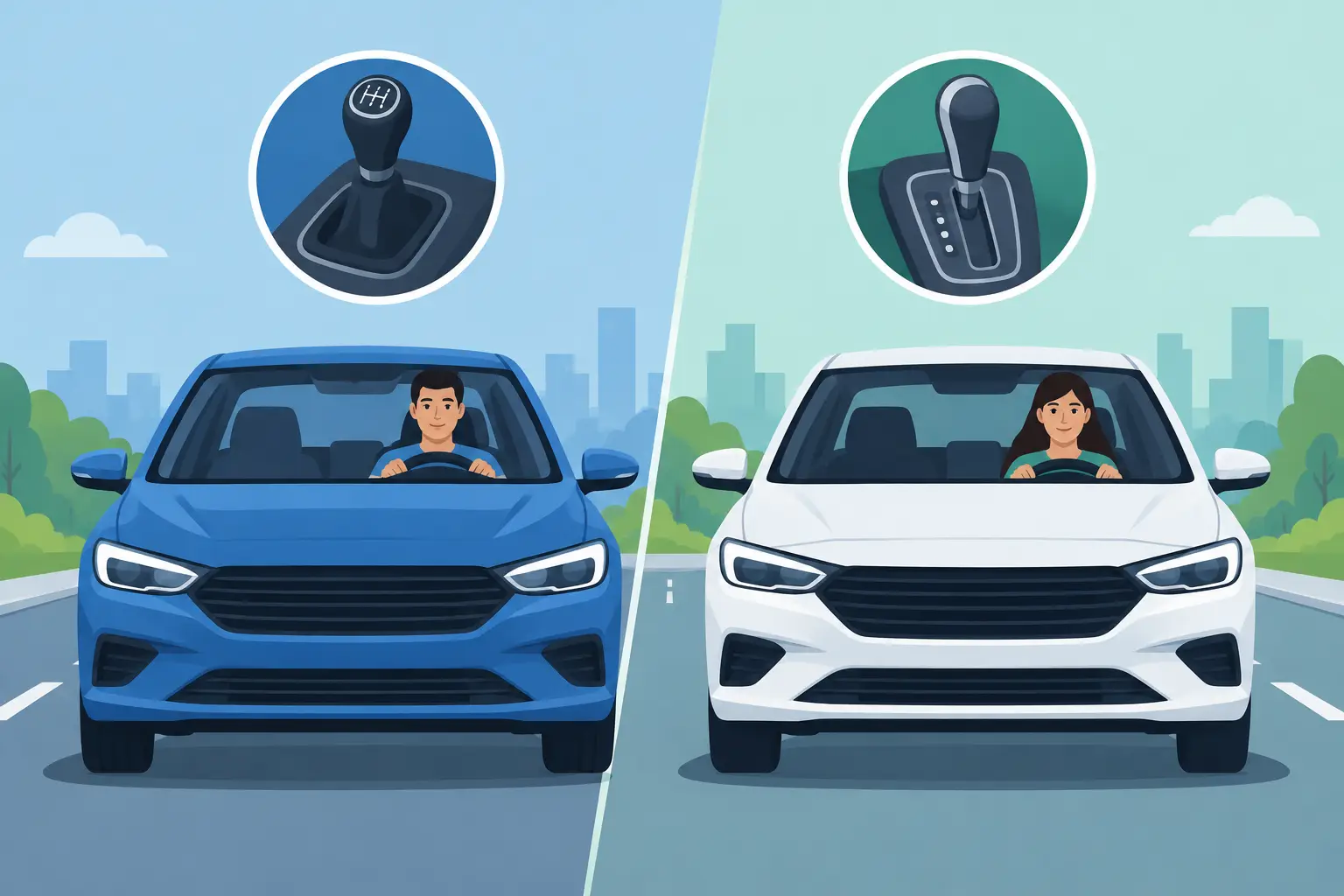
A gearbox decision can affect every lesson you take, the cars you can drive after passing and how quickly you feel comfortable behind the wheel. Manual and automatic driving lessons both lead towards the same goal - a full UK driving licence - but they suit different learners, circumstances and timeframes. The right choice is the one that helps you make steady, safe progress without adding unnecessary pressure.
In a manual car, you use three pedals and change gears yourself with the gear lever. You learn clutch control, moving off smoothly, selecting the appropriate gear and managing the car at low speed. These are useful driving skills, but they take practice, particularly in stop-start traffic, on hills and at busy junctions.
An automatic car has no clutch pedal and changes gear for you. This leaves you with two pedals - accelerator and brake - and allows more of your attention to stay on steering, road position, mirrors, signs and the developing traffic situation. That can make the first few lessons feel less demanding for many learners.
Neither route removes the need to learn safe observation, judgement and control. You will still cover manoeuvres, dual carriageways where appropriate, independent driving, parking and the standard expected for the practical driving test. The difference is how much vehicle control you need to manage at the same time.
This is the most practical point to understand before booking. Pass your practical test in a manual car and you can drive both manual and automatic vehicles, subject to the usual licence conditions. Pass in an automatic and your licence is restricted to automatic cars.
For some learners, that extra flexibility makes manual tuition the clear choice. It may be useful if you expect to borrow or buy an older car, share a vehicle with family, or need the widest choice when looking at used cars. A manual licence can also be helpful where a role involves driving a company vehicle, although you should always check the requirements of a particular employer.
For others, the automatic restriction is not a drawback. Automatic cars are increasingly common, particularly among electric and hybrid models. If you know that an automatic is the car you will drive after passing, learning in one can be a focused and sensible decision. There is no prize for choosing manual if it makes learning more stressful than it needs to be.
Think beyond test day. Ask yourself whether you have access to a manual car, whether your household is likely to change vehicle soon and whether work plans may require flexibility. If your answer is unclear, a manual licence keeps more options open. If your driving needs are clear and automatic-focused, automatic lessons may help you get driving sooner.
Automatic lessons are often easier at the beginning because there are fewer physical tasks to coordinate. A learner can pull away without finding the clutch biting point, and slow traffic is usually less tiring. This can be particularly reassuring for nervous beginners or people returning to lessons after a long break.
That does not mean automatic learning is effortless. You still need to build the routines that make a safe driver: checking mirrors before changing speed or direction, planning ahead, responding calmly to hazards and making controlled decisions at roundabouts and junctions. Automatic pupils can progress quickly with car control, but test readiness still depends on consistent safe driving.
Manual lessons have a steeper early learning curve. Stalling, selecting the wrong gear and rolling back slightly on a hill are common experiences while you develop clutch control. With an experienced Approved Driving Instructor and regular practice, those skills become more natural. Many learners value the confidence that comes from being able to manage a manual car well.
The best question is not simply, “Which is easier?” It is, “Which will help me learn safely and stay motivated?” A learner who feels overwhelmed by manual gears may make better progress in an automatic. A learner who enjoys the challenge and wants maximum licence flexibility may find manual lessons worthwhile.
Your gearbox choice is only one part of planning your course. The amount of tuition you need depends on your previous experience, confidence, availability and how quickly you absorb new skills. DVSA guidance is often used as a useful benchmark, but every learner progresses differently.
A complete beginner generally needs more time than someone who has already had lessons or recently failed a test. A five-hour refresher course can suit a qualified driver rebuilding confidence or a test-standard learner who needs focused support. A longer programme, such as a 30, 40 or 45-hour course, gives beginners more time to develop the skills and judgement required for independent driving.
Intensive learning works well when the course is tailored to your starting point. Lessons held closer together can help you retain what you have practised and identify areas to improve quickly. However, an intensive course should not mean rushing to test before you are ready. A proper assessment of your driving helps set a realistic plan and protects your confidence.
Automatic tuition can be a strong option if you need a licence for work, caring responsibilities or a planned move and will drive an automatic vehicle afterwards. It can also suit learners who have found clutch control a major barrier in previous lessons. Removing that barrier may allow more lesson time for road awareness, manoeuvres and test routes.
It depends on instructor availability and local test demand as well. A managed booking service can help match you with a local instructor and support your search for a suitable practical test, but no course should promise a pass or a test date that is not available. Safe, consistent driving remains the priority.
Manual tuition is often a good fit for learners who want the broadest driving entitlement after passing. It may also make sense when a manual car is available for private practice with a suitable supervising driver. That extra familiarity between lessons can reinforce what you have covered with your instructor.
Choose manual because it meets your likely future needs, not because you feel you ought to. If you are nervous, progress slowly at first or have previously struggled, tell your instructor. A structured approach can break driving down into manageable stages, from moving off and stopping to more complex traffic situations.
Course prices vary by location, lesson length, transmission type and the number of hours required. Automatic lessons can sometimes cost more per hour because automatic instructor and vehicle availability may be more limited in a particular area. A manual course may offer more local choice, but that is not a reason to select it if automatic is genuinely better for you.
Look at the total plan rather than the hourly figure alone. Booking too few hours can lead to extra lessons later, while booking far more than you need is not efficient either. A course recommender or initial discussion about your experience can help you choose a suitable starting point.
For many learners, flexibility matters just as much as price. Choosing a collection location that works around college, work or family commitments can make regular tuition easier to maintain. A deposit-led booking option, such as paying a £175 deposit before arranging the remaining balance, can also make it more straightforward to secure your course while you organise your budget.
Start with your future driving plans, then be honest about how you learn. Manual is the flexible licence choice. Automatic is often the simpler vehicle-control choice. Both can give you the knowledge, road awareness and confidence to drive independently when your tuition is planned around your ability.
If you are unsure, explain your situation when you book: whether you are a complete beginner, have paused lessons, have a test failure to address or need to pass within a particular timeframe. An instructor can assess where you are now and focus your lessons on the skills that will make the biggest difference.
At Intensive Lessons, courses can be arranged with local Approved Driving Instructors in manual or automatic cars, with lesson hours selected around your experience and goals. Choose the course that suits the driving you expect to do, commit to regular practice and let each lesson move you one step closer to getting your licence.


Copyright © 2026 Smart Bookings Ltd. All rights reserved. Registered in England and Wales under company number: 12746265
Smart Bookings LTD is an Introducer Appointed Representative (Financial Services Register No. 989328) of Phoenix Financial Consultants Limited (Phoenix). Phoenix is a credit broker, not a lender. Phoenix is authorised and regulated by the Financial Conduct Authority (FRN: 539195), and offers finance from its panel of lenders. All finance subject to status and credit checks.
