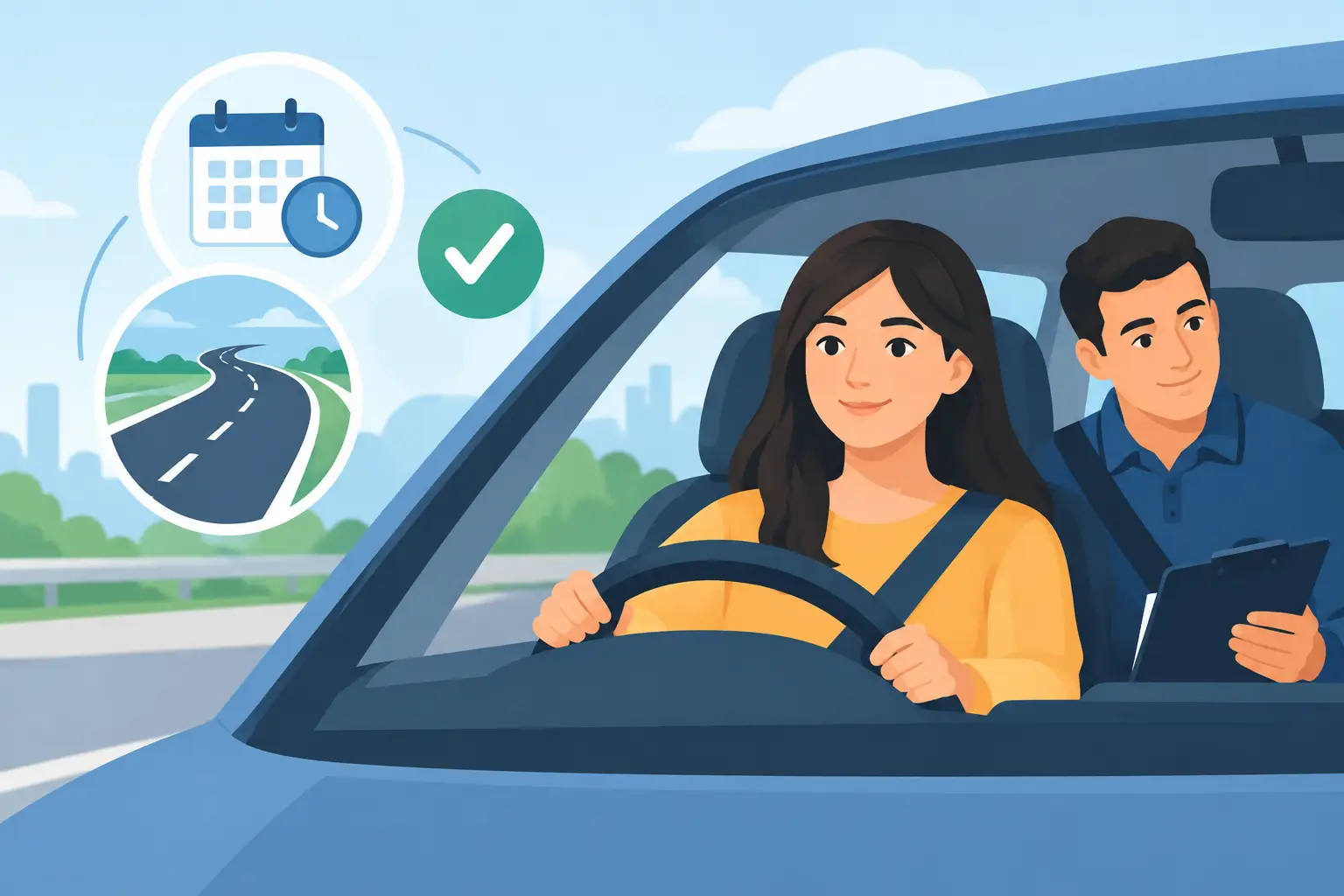
Considering a beginner intensive driving course? See how many hours you may need, what to expect and how to prepare for a practical test with confidence.
Starting from zero can make learning to drive feel like a big commitment. A beginner intensive driving course gives you a clear route from your first time behind the wheel to being ready to take your practical test, with lessons arranged over a concentrated period rather than spread across many months.
For some learners, that focus is exactly what makes progress easier. You spend less time trying to remember what happened in your last lesson, build routines more quickly and keep your confidence moving forward. For others, a slower schedule may be a better fit. The right choice depends on your availability, how comfortably you learn new skills and how close you are to passing your theory test.
What is a beginner intensive driving course?
A beginner intensive course is designed for people with little or no driving experience. It combines a set number of practical tuition hours with a local Approved Driving Instructor, usually delivered across one to several weeks. You can choose manual or automatic tuition, depending on the licence you want to work towards and what feels right for you.
Unlike taking one or two lessons each week, intensive tuition puts regular driving practice into your diary. That consistency can help you become familiar with the car, road layouts, junctions, roundabouts and independent driving in a shorter timeframe.
It is not a shortcut around the skills needed to drive safely. You will still need to develop good judgement, observation and control. The difference is that your learning is organised into a focused plan, tailored to your current level and availability.
How many hours does a complete beginner need?
There is no single number that guarantees a pass. The DVSA advises that learners typically need around 45 hours of professional driving lessons, alongside private practice where it is available. Some people need fewer hours, while others benefit from more time before they are genuinely test-ready.
For a complete beginner, a 45-hour course is often the most realistic starting point. It gives enough time to cover the foundations, practise a broad range of road and traffic conditions, build confidence with manoeuvres and prepare for the practical test. If you have already had lessons, driven with a family member or recently paused your training, a shorter course may be suitable.
Your instructor’s assessment matters more than a fixed deadline. Passing quickly is a useful goal, but passing safely and feeling prepared to drive independently matters more. A good course plan leaves room to adjust if you need extra practice in a particular area.
Manual or automatic: which should you choose?
A manual course leads to a full manual licence if you pass, allowing you to drive both manual and automatic cars. It takes more coordination at the start because you are learning clutch control, gears and timing alongside steering and road awareness.
An automatic course removes the need to change gears, which many beginners find helps them focus earlier on positioning, planning and dealing with traffic. Passing in an automatic gives you an automatic-only licence, so it is worth considering the type of car you expect to drive after your test.
Neither option is automatically easier for every learner. Choose the one that suits your confidence, future driving plans and local instructor availability.
What you will learn during intensive lessons
Your first lessons are about getting comfortable in the driving seat. You will learn the cockpit drill, basic controls, moving away and stopping safely, steering, changing direction and using mirrors effectively. Your instructor will introduce new skills at a pace you can manage.
As you progress, lessons move beyond quiet roads. You will practise meeting traffic, approaching junctions, emerging safely, dealing with roundabouts, following road signs and choosing the correct position. You will also work on planning ahead, recognising hazards and making safe decisions without being prompted at every stage.
Later sessions usually include manoeuvres, such as bay parking and pulling up on the right, as well as rural roads, dual carriageways where appropriate and driving in different weather or traffic conditions. You will also prepare for the independent driving part of the practical test, which involves following a sat nav or traffic signs.
Intensive learning does not mean every hour feels the same. One day may be about mastering clutch control; another may focus on a difficult local roundabout or a manoeuvre that needs another attempt. Regular lessons give you the chance to revisit a skill before it fades from memory.
Is an intensive course right for you?
An intensive course works well when you can protect the time in your diary. You may be finishing college, changing jobs, preparing for a role that requires a licence or simply ready to make driving a priority. Frequent lessons can be particularly helpful for nervous beginners because you are not waiting a full week to get back in the car.
It does require concentration. Several hours of driving tuition in a short period can be tiring, especially when every task is new. Your instructor should structure the sessions with breaks where needed, but you should still arrive rested, well fed and ready to focus.
If you have a busy schedule, find new information overwhelming or cannot commit to consistent lesson dates, weekly lessons may suit you better. There is no advantage in booking an intensive course if work, childcare or other commitments mean you will need to cancel much of it. The best route is the one you can attend and engage with fully.
Prepare before your course begins
A small amount of preparation can make your practical tuition more productive. You do not need to know how to drive before your first lesson, but understanding the road rules gives you more headspace once you are in the car.
Make sure you have a valid provisional licence and start preparing for your theory test early. The theory test must be passed before you can take a practical test, so leaving it until the end can delay your plans. Revise both multiple-choice questions and hazard perception, rather than relying on one format alone.
It also helps to wear comfortable shoes with a thin, secure sole so you can feel the pedals properly. Bring any glasses or contact lenses you need for driving, and let your instructor know in advance if you are particularly anxious, have previous driving experience or need to work around a specific schedule.
Private practice can be useful if it is available to you, but it is not essential. If you do practise with a friend or family member, make sure you are properly insured and that the accompanying driver meets the legal requirements. Use that time to reinforce what your instructor has taught rather than trying to learn conflicting methods.
Choosing a course with the right support
A course is not only about the total number of hours. Look for an organised booking process, a clear explanation of what your course includes and an instructor who is approved, experienced and able to adapt lessons to your progress. Collection from home, work or another agreed location can also make a concentrated schedule easier to manage.
Test availability is another practical consideration. A responsible provider will help you plan around your theory status, readiness and local test options, but should never promise a pass date before your instructor believes you are ready. Test-focused support is useful; pressure to sit the test too soon is not.
Intensive Lessons coordinates beginner courses with local Approved Driving Instructors across much of the UK, so you can choose a course pathway, secure your booking with a deposit and get driving with a structured plan in place.
Make progress, not just a booking
Your first lesson may feel unfamiliar, and your first roundabout may feel like a lot to process. That is normal. Each successful move-off, safe junction approach and independent decision adds to the confidence you need on test day and beyond. Choose a course that gives you enough time, listen to your instructor’s feedback and keep the focus on becoming a safe driver for life.
Last Updated: 13/11/2026